


By Jason Gray, University of California, Los Angeles
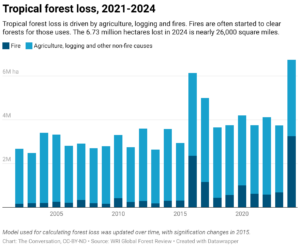
The world is losing vast swaths of forests to agriculture, logging, mining and fires every year — more than 20 million acres in 2024 alone, roughly the size of South Carolina.
That’s bad news because tropical forests in particular regulate rainfall, shelter plant and animal species and act as a thermostat for the planet by storing carbon, keeping it out of the atmosphere where it would heat up the planet. The United Nations estimates that deforestation and forest degradation globally contribute about 11% of total greenhouse gas emissions.
Over the years, countries have committed to reverse that forest loss, and many organizations, governments, and Indigenous and local communities have worked hard to advance those goals. Many of their efforts have been at least partly successful.
For instance, Brazil credits stronger law enforcement and better monitoring at the state and national levels for helping reduce illegal land clearing and deforestation in the Amazon. The deforestation rate there fell by 31% from 2023 to 2024.
Funding from governments and the private sector is helping communities restore land that has already been cleared. Other programs protect forests through payments for ecosystem services, such as paying landowners to maintain existing forests and the benefits those forests provide. These programs provide money to a government, community or landowner based on verified results that the forest is being protected over time.
And yet, despite these and many other efforts, the world is falling short on its commitments to protect tropical forests. The planet lost 6.7 million hectares of tropical forest, nearly 26,000 square miles (67,000 square kilometers), in 2024 alone.
Law enforcement is not enough by itself. When enforcement is weakened, as happened in Brazil from 2019 to 2023, illegal land clearing and forest loss ramp back up. Programs that pay landowners to keep forests standing also have drawbacks. Research has shown they might only temporarily reduce deforestation if they don’t continue payments long term.
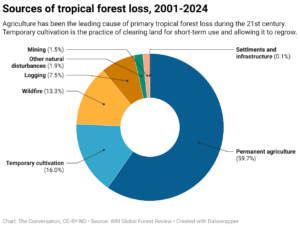
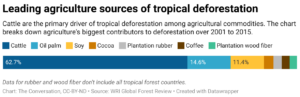
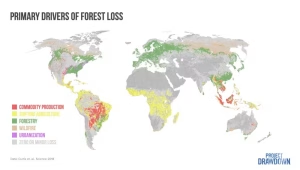
The problem is that deforestation is often driven by economic factors such as global demand for crops, cattle and minerals such as gold and copper. This demand provides significant incentives to farmers, companies and governments to continue clearing forests.
The amount of money committed to protecting forests globally is about US$5.7 billion per year – a fraction of the tens of billions of dollars banks and investors put into the companies that drive deforestation.
Simply put, the scale of the deforestation problem is massive, and new efforts are needed to truly reverse the economic drivers or causes of deforestation.
In order to increase the amount of funding to protect tropical forests, Brazil launched a global program on Nov. 6, ahead of the annual U.N. climate conference, called the Tropical Forest Forever Facility, or TFFF. It is an innovative approach that combines money from countries and private investors to compensate countries for preserving tropical forests.
As an environmental law scholar who works in climate policy development, including to protect tropical forests, I believe this program has real promise. But I also see room to improve it by bringing in states and provinces to ensure money reaches programs closer to the ground that will pay off for the environment.
What makes the Tropical Forest Forever Facility different?
The Tropical Forest Forever Facility seeks to tackle the deforestation problem by focusing on the issue of scale – both geographic and economic.
First, it will measure results across entire countries rather than at the smaller landowner level. That can help reduce deforestation more broadly within countries and influence national policies that currently contribute to deforestation. It focuses on the amount of forest area protected rather than estimating the amount of carbon in the trees.
Second, it seeks to raise billions of dollars. This is important to counter the economic incentives for clearing forests for agriculture, livestock and timber.
The mechanics of raising these funds is intriguing – Brazil is seeking an initial $25 billion from national governments and foundations, and then another $100 billion from investors. These funds would be invested in securities – think the stock and bond markets – and returns on those investments, after a percentage is paid to investors, would be paid to countries that demonstrate successful forest protection.
These countries would be expected to invest their results-based payments into forest conservation initiatives, in particular to support communities doing the protection work on the ground, including ensuring that at least 20% directly supports local communities and Indigenous peoples whose territories often have the lowest rates of deforestation thanks to their efforts.
Finally, the Tropical Forest Forever Facility recognizes that, like past efforts, it is not a silver bullet. It is being designed to complement other programs and policies, including carbon market approaches that raise money for forest protection by selling carbon credits to governments and companies that need to lower their emissions.
What has been the reaction so far?
The new forest investment fund is attracting interest because of its size, ambition and design.
Brazil and Indonesia were the first to contribute, committing $1 billion each. Norway added $3 billion on Nov. 7, and several other countries also committed to support it.
The Tropical Forest Forever Facility still has a long way to go toward its $125 billion goal, but it will likely draw additional commitments during the U.N. climate conference, COP30, being held Nov. 10-21 in Brazil. World leaders and negotiators are meeting in the Amazon for the first time.
How can the Tropical Forest Forever Facility be improved?
The Tropical Forest Forever Facility’s design has drawn some criticism, both for how the money is raised and for routing the money through national governments. While the fund’s design could draw more investors, if its investments don’t have strong returns in a given year, the fund might not receive any money, likely leaving a gap in expected payments for the programs and communities protecting forests.
Many existing international funding programs also provide money solely to national governments, as the Amazon Fund and the U.N.’s Global Environment Facility do. However, a lot of the actual work to reduce deforestation, from policy innovation to implementation and enforcement, takes place at the state and provincial levels.
One way to improve the Tropical Forest Forever Facility’s implementation would be to include state- and provincial-level governments in decisions about how payments will be used and ensure those funds make it to the people taking action in their territories.
The Governors’ Climate and Forests Task Force, a group of 45 states and provinces from 11 countries, has been giving feedback on how to incorporate that recommendation.
The task force developed a Blueprint for a New Forest Economy, which can help connect efforts such as the Tropical Forest Forever Facility to state- and community-level forest protection initiatives so funding reaches projects that can pay off for forest protection.
The Tropical Forest Forever Facility is an example of the type of innovative mechanism that could accelerate action globally. But to truly succeed, it will need to be coordinated with state and provincial governments, communities and others doing the work on the ground. The world’s forests – and people – depend on it.
Jason Gray is an environmental attorney in the Emmett Institute on Climate Change and the Environment at the University of California, Los Angeles.
This article is republished from The Conversation under a Creative Commons license. Read the original article. Banner photo: An area of felled and burned trees seen in the Brazilian Amazon. (Amazônia Real from Manaus AM, Brasil, CC BY 2.0, via Wikimedia Commons).
Sign up for The Invading Sea newsletter by visiting here. To support The Invading Sea, click here to make a donation. If you are interested in submitting an opinion piece to The Invading Sea, email Editor Nathan Crabbe at ncrabbe@fau.edu.
